
Drool Rash vs Eczema in Babies: How to Tell the Difference
Key Takeaways
A drool rash is usually an irritant reaction that develops when saliva repeatedly stays on a baby's skin, especially around the mouth, chin, cheeks, or neck.
Atopic dermatitis, commonly called baby eczema, is a chronic inflammatory skin condition associated with an impaired skin barrier and immune-system activity.
You can compare drool rash and eczema by looking at drooling, itching, dryness, recurrence, and rash location.
Babies can have both conditions, with saliva potentially irritating eczema-prone skin.
Gentle skin care can help, but persistent, worsening, painful, or infected-looking rashes need medical evaluation.
Introduction
A baby’s cheeks or chin may suddenly look red, dry, rough, or irritated. When this happens, parents may wonder whether they are seeing drool rash or eczema.
The two can look similar, especially on a baby’s face, but their underlying causes differ. A drool rash usually develops when repeated saliva and moisture irritate sensitive skin. Frequent wiping can add friction and worsen the irritation.
Atopic dermatitis, commonly called eczema, is an inflammatory skin condition that often causes dry, itchy, and inflamed skin. It can flare and improve over time.
Knowing the differences between drool rash vs eczema can help parents understand what they may be seeing and when to seek professional advice.
Quick Answer
Drool rash usually develops where saliva repeatedly wets and irritates a baby’s skin, especially around the mouth, chin, and neck. Eczema is an inflammatory skin condition that can cause itchy, dry, irritated patches and affect several areas. Babies can have both, so persistent or worsening rashes need medical evaluation.
What Does Drool Rash Look Like?
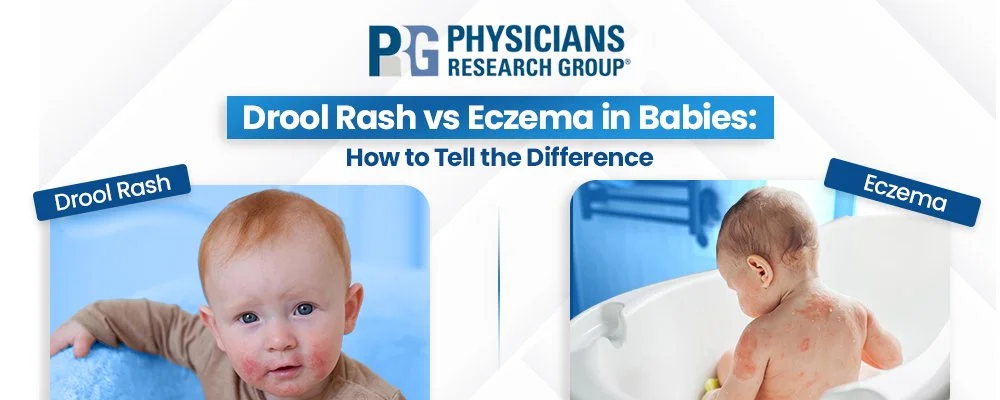
If you suspect your baby may have this condition, you may wonder: what does drool rash look like? It often appears as red, irritated, dry, or rough skin where saliva repeatedly touches the skin. Some babies may also develop small bumps or chapped-looking patches.
The rash is most common around the mouth and chin. However, it can spread to the cheeks or neck when those areas are frequently exposed to saliva. The appearance can vary, so a rash should not be identified as drool rash based on appearance alone.
What Causes Drool Rash in Babies?
Drool rash is usually related to repeated saliva exposure.
Saliva itself is not harmful to a baby's skin. The problem is prolonged moisture and repeated exposure, particularly when the skin is constantly wet and then wiped or rubbed.
Frequent wiping can create additional friction. Food residue around the mouth may also irritate the skin, particularly once a baby begins eating solid foods.
Teething may indirectly contribute because babies often drool more while teething. The rash itself, however, is related to the skin's exposure to saliva rather than teething being a direct skin disease.
Does Drool Cause a Rash Around a Baby’s Mouth?
Yes. Frequent saliva exposure can irritate the skin around a baby's mouth and chin.
However, not every rash around a baby's mouth is a drool rash.
If the rash is primarily confined to areas that frequently become wet with saliva and improves when moisture and friction are reduced, irritation from drooling may be contributing.
If the baby has persistent itching, very dry or scaly patches, recurrent flares, or similar areas of rash elsewhere, eczema may also be involved.
The distinction is not always either-or.
What Is Atopic Dermatitis in Babies?
Atopic dermatitis is a chronic inflammatory skin condition that can affect babies and young children. It is associated with changes in the skin barrier and immune response, which can leave skin dry, irritated, and more sensitive to triggers. It often causes itching and may improve and flare repeatedly.
Unlike a drool rash, atopic dermatitis is not simply caused by saliva touching the skin. However, saliva and repeated wiping can irritate skin that is already sensitive or eczema-prone.
Atopic dermatitis (the most common type of eczema) affects up to 25% of children worldwide, according to the American Academy of Dermatology’s 2026 pediatric guidelines.
What Does Baby Eczema Look Like?
If you are wondering, what does baby eczema look like? Common signs may include:
Dryness: Skin may feel dry, rough, or less smooth than usual.
Redness: Affected areas may look red or inflamed.
Rough or scaly patches: The skin can become rough, flaky, or scaly.
Itching: Babies may rub or scratch the affected area because eczema can be itchy.
Open or crusted areas: Scratching can sometimes damage the skin and lead to open or crusted spots.
The appearance of eczema can vary with a baby’s age and skin tone. Therefore, it may not look exactly the same in every infant.
Is Eczema Itchy in Babies?
Yes. Itching is one of the most important features of atopic dermatitis.
A baby cannot tell you that their skin itches, so parents may notice behaviors instead. A baby may rub the affected skin against blankets, clothing, carpeting, or other surfaces.
Persistent rubbing can make the skin raw and may cause areas to ooze or crust.
This is one reason itching can be a useful clue when considering drool rash vs eczema.
Where Does Infant Eczema Usually Appear?
In babies, atopic dermatitis commonly affects the:
Cheeks.
Forehead.
Scalp.
Trunk.
Arms.
Legs.
The exact distribution varies with age and the individual child. This means that location alone cannot determine whether a facial rash is eczema.
Drool Rash vs Eczema: Key Differences
The drool rash vs eczema comparison becomes more useful when several features are considered together.
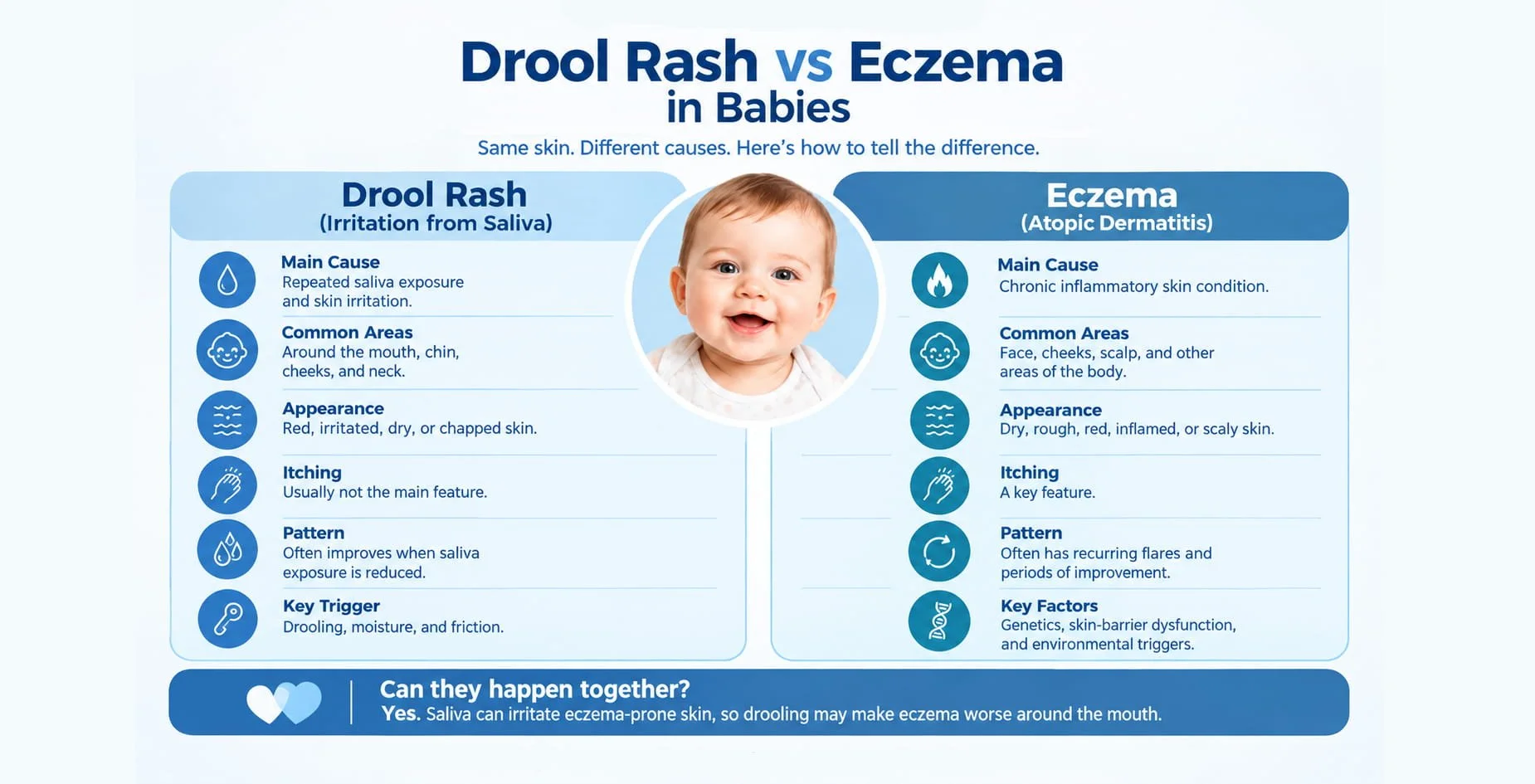
| Feature | Drool Rash | Baby Eczema |
|---|---|---|
| Underlying process | Irritation from repeated saliva, moisture, and friction. | Inflammatory skin disease associated with skin-barrier and immune-system changes. |
| Relationship to drooling | Usually closely related. | Not caused by drooling, although saliva can aggravate affected skin. |
| Common areas | Mouth, chin, cheeks, neck, and other areas where saliva collects. | Often cheeks, forehead, scalp, trunk, arms, or legs in babies. |
| Itching | May be uncomfortable or irritated, but itching is not the defining feature. | Often intensely itchy. |
| Skin texture | May become irritated, dry, rough, or chapped. | Often dry, rough, scaly, inflamed, or bumpy. |
| Pattern over time | Often follows periods of increased moisture or drooling. | Often follows a recurring flare-and-improvement pattern. |
| Friction | Repeated wiping can worsen irritation. | Rubbing and scratching can worsen inflammation and damage the skin. |
| Can they coexist? | Yes. | Yes. |
These differences are useful clues, not diagnostic rules.
A baby with eczema can develop a saliva-related irritant rash around the mouth. Conversely, a rash that looks like eczema may actually have another cause.
Can Drool Rash and Eczema Occur Together?
Yes.
In fact, this is an important part of the drool rash vs eczema discussion because the two conditions do not have to be mutually exclusive.
A baby may already have atopic dermatitis on the cheeks and then develop additional irritation when saliva repeatedly sits on the affected skin.
Eczema involves a compromised skin barrier, which can make skin more vulnerable to irritation. Frequent wiping may then add friction to an already inflamed area.
This can make the rash appear worse even though drooling did not cause the underlying eczema.
For that reason, parents should not assume that every rash around a drooling baby's mouth is simply a drool rash.
How Is a Baby's Rash Diagnosed?
A clinician can usually begin evaluating a baby's rash by examining the skin and asking about the child's symptoms and medical history.
They may ask:
When did the rash begin?
Where did it first appear?
Has it spread?
Does the baby seem itchy?
Is the baby drooling more than usual?
What makes the rash better or worse?
Does it keep coming back?
Has the baby started any new skin-care products?
Are there signs of infection?
Does the baby have any other symptoms?
For many uncomplicated cases, the diagnosis can be made clinically without extensive testing.
If the appearance is unusual, the diagnosis is uncertain, or the rash does not improve as expected, the clinician may consider other causes or additional evaluation.
Parents should avoid trying to diagnose an infant's rash based solely on an online photograph or symptom checklist.
How Should You Care for a Suspected Drool Rash?
The goal is to reduce prolonged moisture and protect the skin from additional irritation.
Helpful measures include:
Gently pat the skin dry instead of rubbing it.
Use a soft, absorbent bib and change it when it becomes wet.
Gently wipe saliva from the baby's chin, cheeks, and neck.
Use mild, fragrance-free products when cleansing the skin.
Avoid unnecessary friction.
Ask your baby's pediatrician whether a protective barrier ointment is appropriate.
The AAP specifically recommends soft absorbent bibs, frequent bib changes, gentle wiping, and asking a pediatrician about a barrier cream or ointment. It also recommends avoiding fragranced or irritating laundry products.
The goal is not to scrub the saliva away. Repeated rubbing can add another source of irritation.
How Is Baby Eczema Treated?
Eczema treatment focuses on supporting the skin barrier and controlling inflammation.
Common recommendations include:
Regular use of fragrance-free moisturizers
Gentle skin care
Short, lukewarm baths
Avoiding known irritants
Following a healthcare professional's treatment plan
The AAD recommends thick creams or ointments because they generally moisturize more effectively than lotions or oils. If medication is needed, a clinician can recommend an appropriate treatment based on the baby's age, affected area, and eczema severity.
Parents should not use prescription eczema medication on an infant without medical guidance.
When Should a Baby's Rash Be Checked by a Doctor?
Contact a healthcare professional if the rash is persistent, worsening, widespread, painful, or difficult to manage.
Evaluation is especially important if the rash:
Spreads rapidly
Develops swelling, pus, sores, or extensive crusting
Shows signs of infection
Occurs with fever or a baby who seems unwell
Does not improve with appropriate skin care
Keeps returning without a clear cause
Eczema can become infected when a weakened skin barrier allows microorganisms to enter.
Seek urgent medical attention if a baby has difficulty breathing, appears seriously ill, or develops another emergency symptom.
Learning More About Pediatric Eczema Research
If your baby's rash keeps coming back or does not improve with appropriate skin care, talking with a healthcare professional can help clarify whether it is eczema or another skin condition.
For parents who want to learn more about treatment options being studied for pediatric eczema, clinical trials may be worth exploring. Physicians Research Group (PRG) conducts clinical research, including studies focused on pediatric atopic dermatitis. Parents can learn more about pediatric atopic dermatitis clinical trials to see what studies are available and what participation involves.
If you have questions about a study or eligibility, you can also contact our team for more information.
Conclusion
Knowing the difference between drool rash and eczema can help parents understand what may be causing a baby's irritated skin. Drool rash is usually linked to repeated saliva exposure, while eczema is a chronic inflammatory condition that often causes dry, itchy, irritated skin.
Because these conditions can sometimes look similar or occur together, persistent or worsening rashes should be evaluated by a healthcare professional. With the right diagnosis and care, parents can better manage their baby's skin and know when further evaluation may be needed.
FAQs
-
Drool rash usually develops where saliva repeatedly contacts the skin, such as around the mouth, chin, cheeks, and neck. Eczema is often dry and itchy and can affect other areas of the baby's skin.
-
No. Drool does not cause eczema, but repeated saliva exposure can irritate sensitive or eczema-prone skin and make existing irritation worse.
-
A drool rash often looks like red, irritated, dry, or slightly bumpy skin around areas exposed to saliva. It commonly affects the mouth, chin, cheeks, and neck.
-
Yes. Itching is a common feature of atopic dermatitis. Babies may rub or scratch affected areas because they cannot always communicate that their skin feels itchy.
-
Yes. A baby with eczema can also develop a drool rash. Saliva can further irritate skin that is already dry or inflamed.
-
A drool rash often improves when saliva exposure and skin irritation are reduced. If the rash persists or does not improve with appropriate skin care, have your baby's skin evaluated by a healthcare professional.