
Plaque Psoriasis on Face: Causes, Symptoms, and Treatment
Key Takeaways
Plaque psoriasis on face is an inflammatory form of psoriasis that can cause raised, dry, scaly, itchy, or irritated patches.
Facial psoriasis can look different depending on skin tone, severity, and the area affected.
Psoriasis develops through an abnormal immune response. Genetics and environmental factors can contribute, while certain triggers may cause flares.
Facial skin is sensitive, so treatments used on thicker body skin may not be suitable for the face or around the eyes.
Prescription topical medicines are often used, while phototherapy or systemic treatments may be considered for more extensive disease.
Facial psoriasis is not contagious.
Psoriasis is generally chronic, but treatment can control symptoms and periods of clear skin can occur.
A dermatologist can help confirm the diagnosis and choose an appropriate treatment plan.
Introduction
A rash on the face can be difficult to ignore, especially when it is itchy, flaky, or keeps coming back. When the cause is plaque psoriasis on face, treatment also requires extra care because facial skin is thinner and more sensitive than many other areas of the body.
Facial psoriasis can affect different parts of the face, including the forehead, eyebrows, eyelids, cheeks, and skin around the nose. It may occur alongside psoriasis on the scalp or elsewhere on the body.
Understanding what the condition looks like, what can trigger it, and how treatment differs from psoriasis on thicker skin can make it easier to know what to do next. This guide explains the symptoms, causes, diagnosis, treatment, self-care, and common differences between facial psoriasis, eczema, and rosacea.
Quick Answer: Plaque psoriasis on face is a chronic inflammatory skin condition that can cause raised, dry, scaly, or irritated patches. Its appearance varies by skin tone and severity. Treatment may include carefully selected topical medicines and, for some people, phototherapy or systemic treatment under medical supervision.
What Is Plaque Psoriasis on Face?
Plaque psoriasis is the most common form of psoriasis. It develops when the immune system becomes overactive and drives inflammation and unusually rapid growth of skin cells. The extra cells accumulate at the skin surface, creating plaques.
When these plaques develop on the face, the condition is referred to as facial psoriasis. Plaque psoriasis on face may affect the forehead, hairline, eyebrows, cheeks, eyelids, area around the nose, ears, or skin around the mouth.
Facial psoriasis may occur with psoriasis on other parts of the body. Some people also have scalp psoriasis that extends toward the forehead or hairline.
The face presents a treatment challenge because the skin is relatively thin and sensitive. A medicine that is appropriate for a thick plaque on the elbow, for example, may not be appropriate for prolonged use on facial skin.
That is why treatment should be selected according to the location as well as the severity of the psoriasis.
What Does Psoriasis on the Face Look Like?
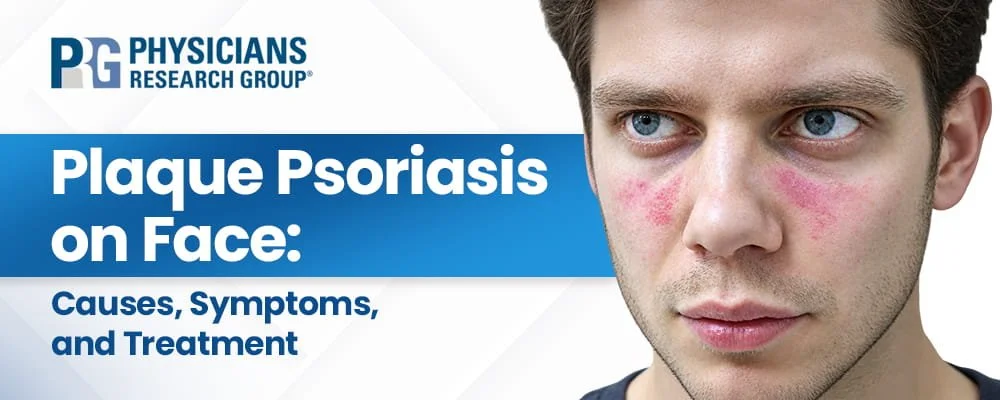
So, what does psoriasis on face look like? There is no single appearance that applies to everyone.
Facial psoriasis may cause patches that are:
Raised or slightly thickened
Dry or scaly
Clearly defined
Itchy or irritated
Sore or sensitive
Different in color from the surrounding skin
On lighter skin, inflammation may appear pink or red. On darker skin, psoriasis may look brown, violet, gray, or darker than the surrounding skin. Scaling can also be more or less noticeable depending on skin tone.
Some facial plaques are relatively thin compared with psoriasis on the elbows or knees. Psoriasis near the hairline may also appear as an extension of scalp psoriasis.
Because several skin conditions can cause facial redness, scaling, or irritation, what does psoriasis on face look like cannot be used as a substitute for diagnosis. Eczema, seborrheic dermatitis, rosacea, contact dermatitis, and other conditions can sometimes resemble facial psoriasis.
What Are the Facial Plaque Psoriasis Symptoms?
The appearance of a rash is only part of the picture. Facial plaque psoriasis symptoms can also affect how the skin feels.
Common symptoms include:
Itching
Dryness
Scaling or flaking
Soreness
Irritation
Skin sensitivity
Cracking when the skin becomes very dry
The intensity of these symptoms varies. One person may mainly notice visible scaling, while another may experience considerable itching or sensitivity.
Some people also find facial psoriasis emotionally difficult because the affected skin is visible. This does not change the medical nature of the condition, but it is a legitimate part of living with a visible chronic skin disorder.
If facial symptoms are persistent, worsening, or difficult to identify, a medical evaluation can help determine whether psoriasis is actually responsible.
What Causes Psoriasis on Face?
When asking "What causes psoriasis on face?", it helps to separate the underlying cause from factors that can trigger a flare.
Psoriasis is an immune-mediated inflammatory condition. The immune system becomes abnormally active and contributes to inflammation and faster-than-normal production of skin cells. Genetics also play an important role, which is why psoriasis can run in families.
The exact reason one person develops psoriasis while another does not is not fully understood. Environmental factors can interact with genetic susceptibility.
Common factors that may trigger or worsen psoriasis include:
Stress
Certain infections
Skin injury, including cuts or scratches
Cold, dry weather
Sunburn
Smoking
Heavy alcohol use
Certain medications
These are triggers, not necessarily the underlying cause of psoriasis. For example, experiencing stress before a flare does not mean stress caused the person's psoriasis in the first place.
Triggers also vary between individuals. A factor that worsens symptoms for one person may have little effect on someone else.
If a medication appears to be associated with a flare, it should not be stopped without first speaking with the prescribing healthcare professional.
Where Can Facial Psoriasis Appear?
Plaque psoriasis on face can affect several areas rather than one specific part of the face. Common locations include the:
Forehead
Hairline
Eyebrows
Eyelids
Cheeks
Skin around the nose
Ears or skin around the ears
Area around the mouth
Facial psoriasis may also occur with scalp psoriasis. In some people, psoriasis from the scalp extends beyond the hairline onto the forehead.
Psoriasis Around the Eyes:
Psoriasis around the eyes deserves particular attention because the eyelid and surrounding skin are delicate.
Symptoms may include dryness, scaling, irritation, or visible patches on the eyelids or nearby skin. Treatment in this area should be guided by a healthcare professional.
Strong or prolonged use of topical corticosteroids around the eyes can cause unwanted effects, so people should not assume that a treatment used safely on another part of the body is appropriate for the eyelids.
Eye symptoms such as pain, significant redness inside the eye, light sensitivity, or vision changes also warrant prompt medical assessment rather than self-treatment.
Psoriasis Around Nose:
Psoriasis can affect the skin around the nose, including the folds beside the nostrils. Dryness and scaling in this area may become irritating, particularly when the skin is repeatedly rubbed or exposed to harsh products.
It is important to distinguish psoriasis affecting the external skin from symptoms occurring inside the nose. Persistent irritation inside the nose may have another cause and should be assessed if it does not resolve.
Gentle skin care and a dermatologist-directed treatment plan can help reduce irritation in this sensitive facial area.
How to Treat Psoriasis on Face
Treatment for plaque psoriasis on face depends on its severity, location, symptoms, and medical history. Because facial skin is sensitive, treatments should be selected carefully by a healthcare professional.
Topical corticosteroids: May help reduce inflammation, itching, and scaling when used appropriately.
Topical vitamin D analogues: May be considered for some people with facial psoriasis.
Topical calcineurin inhibitors: May be used for sensitive facial areas when appropriate.
Phototherapy: May be considered when topical treatments are not enough.
Systemic or biologic treatments: May be options for extensive or difficult-to-control psoriasis.
Treatments suitable for thicker skin may not be appropriate for prolonged use on the face, so medical guidance is important when deciding how to treat psoriasis on face.
Ready to Explore New Options for Plaque Psoriasis?
Clinical research may offer access to investigational treatments while helping advance psoriasis care.
How Can You Care for Facial Skin With Psoriasis?
Selfcare for psoriasis on face can support medical treatment, but it does not replace treatment prescribed for active psoriasis.
Helpful habits may include:
Cleanse gently rather than scrubbing affected skin.
Use a moisturizer regularly to reduce dryness.
Avoid skincare products that consistently sting or irritate your skin.
Avoid picking or scratching plaques.
Protect the skin from sunburn.
Pay attention to personal flare triggers.
Follow your prescribed treatment as directed.
It can also help to introduce new skincare products cautiously, particularly if your skin is already inflamed.
The goal of selfcare for psoriasis on face is to reduce unnecessary irritation and support the skin barrier while the underlying psoriasis is being treated.
Facial Psoriasis vs Eczema: What's the Difference?
Facial psoriasis and eczema can look similar, and appearance alone does not always provide a reliable diagnosis.
| Condition | Common Appearance | Common Symptoms | Key Difference |
|---|---|---|---|
| Facial plaque psoriasis | Well-defined, raised or thickened patches with scale | Itching, dryness, soreness | Often has more clearly defined plaques and may occur with psoriasis elsewhere |
| Eczema | Dry, inflamed, irritated skin; appearance can vary | Often prominent itching and irritation | Commonly associated with a history or pattern of eczema, but facial presentations can overlap |
| Rosacea | Persistent facial color changes, flushing, visible vessels or acne-like bumps | Burning, stinging, flushing | Primarily affects the face and commonly involves flushing or persistent facial color changes |
A person can also have more than one skin condition. If a facial rash does not respond as expected to treatment, reassessing the diagnosis may be appropriate.
Facial Psoriasis vs Rosacea: How Are They Different?
Facial redness does not automatically mean someone has psoriasis.
Rosacea mainly affects the face and can cause flushing, persistent changes in skin color, visible blood vessels, acne-like bumps, or eye symptoms. Psoriasis, by contrast, more often produces defined, scaly plaques.
The distinction can become less obvious on darker skin tones because redness may be less visually apparent. Symptoms such as scaling, texture changes, burning, flushing, and the exact location of the rash can all help a clinician determine the likely cause.
Triggers can differ as well. Rosacea commonly involves flushing triggers, while psoriasis may flare in response to factors such as stress, infection, skin injury, weather changes, or certain medications.
Because the treatments are different, persistent facial redness or scaling should not be self-diagnosed as psoriasis.
Is Facial Psoriasis Contagious?
No. Facial psoriasis is not contagious.
You cannot catch psoriasis from touching someone who has it, hugging them, kissing them, or sharing the same space.
Psoriasis results from an abnormal immune response and genetic and environmental factors. It is not an infection that spreads from person to person.
This is important to remember when psoriasis affects a highly visible area such as the face.
Can Psoriasis on Face Go Away?
Many people ask, can psoriasis on face go away completely?
Psoriasis is generally a chronic condition, so there is currently no permanent cure. However, symptoms can improve significantly with appropriate treatment, and some people experience periods when their skin becomes clear or nearly clear.
These periods are often described as remission. A remission can end, and psoriasis can return later.
So, can psoriasis on face go away for a period of time? Yes, symptoms can clear or become much less noticeable. But clear skin does not necessarily mean the underlying condition has permanently disappeared.
The goal of treatment is to control inflammation, reduce symptoms, maintain clearer skin, and limit flares as much as possible.
When Should You See a Doctor About Facial Psoriasis?
It is worth seeking medical evaluation if you have a persistent facial rash that you cannot identify, particularly because psoriasis can resemble eczema, rosacea, seborrheic dermatitis, and other conditions.
See a healthcare professional if:
The rash continues or keeps returning.
Symptoms are becoming worse.
Treatment is not helping.
The diagnosis is uncertain.
The rash is affecting your daily activities.
Psoriasis is affecting the eyelids or area around the eyes.
Psoriasis is widespread or difficult to control.
A dermatologist can usually diagnose psoriasis by examining the skin and asking about symptoms, medical history, family history, and other areas of the body. In some uncertain cases, a small skin biopsy may be needed.
If you have joint pain, swelling, or prolonged morning stiffness along with psoriasis, mention these symptoms to your healthcare professional because psoriasis can occur with psoriatic arthritis.
Could Clinical Research Be an Option for Plaque Psoriasis?
People whose plaque psoriasis on face continues to affect them despite standard treatment may also want to learn about clinical research.
Clinical trials are structured studies that evaluate potential treatments under defined protocols. Whether someone can participate depends on the specific study, medical history, age, disease severity, previous treatment, and other eligibility requirements.
Physicians Research Group (PRG) conducts clinical research studies in several areas, including dermatology. People interested in research can learn more about clinical research opportunities through PRG.
PRG also provides information about plaque psoriasis clinical trials and studies involving moderate-to-severe plaque psoriasis clinical trials. These opportunities can change as studies open, close, or update their eligibility criteria.
Clinical research is optional, and reading about a study does not mean that a person qualifies. Anyone interested can contact PRG to learn more about available research opportunities and study requirements.
Read more about Physicians Research Group.
There May Be Another Option to Consider
If plaque psoriasis is affecting your daily life, you may qualify for a clinical research study.
Conclusion
Plaque psoriasis on face can cause visible plaques, scaling, dryness, itching, and irritation, but its appearance and severity vary from person to person.
Because facial skin is sensitive, treatment needs to be selected carefully. A dermatologist can help distinguish psoriasis from conditions such as eczema and rosacea and choose treatment appropriate for the affected area.
Although psoriasis is generally chronic, symptoms can be controlled and periods of clear skin can occur. If a facial rash persists, worsens, or affects sensitive areas such as the eyes, professional evaluation is the safest next step.
FAQs
-
It may appear as raised, dry, scaly, or clearly defined patches. The color can vary by skin tone and may look red, pink, violet, brown, gray, or darker than surrounding skin.
-
No. Psoriasis on the face is not contagious. It cannot be transmitted through touching, hugging, kissing, or sharing personal or living spaces.
-
The exact cause is not fully understood. What causes psoriasis on face involves an abnormal immune response combined with genetic susceptibility and environmental influences. Triggers such as stress, infections, skin injury, weather changes, and certain medications can contribute to flares.
-
Treatment depends on the severity and location. Treatment may include carefully selected topical medicines, such as corticosteroids or calcineurin inhibitors. Phototherapy or systemic treatment may be considered for some people with more extensive or difficult-to-control psoriasis.
-
Psoriasis is generally chronic, but treatment can make symptoms clear or nearly clear for periods of time. These periods of remission can end, and symptoms may return.
-
No. Facial psoriasis and eczema are different inflammatory skin conditions, although they can look similar. Psoriasis often causes more defined plaques with scale, while eczema commonly causes significant itching and irritated, dry skin. A clinician may need to examine the rash to distinguish them.
-
Yes. Psoriasis can affect the eyelids and skin around the eyes. Because this area is delicate, treatment should be guided by a healthcare professional. Eye pain, vision changes, or significant inflammation inside the eye should be evaluated promptly.