
What Does Facial Psoriasis Look Like? How to Identify the Signs
Key Takeaways
Facial psoriasis can cause dry, scaly, discolored, raised, or irritated patches on different areas of the face.
Its appearance may vary by skin tone, psoriasis type, and the affected area.
Facial psoriasis can resemble eczema, seborrheic dermatitis, rosacea, and fungal infections.
A healthcare professional can diagnose facial psoriasis by examining the skin and reviewing symptoms.
Treatment depends on the severity and location of symptoms, especially when sensitive areas such as the eyes are affected.
Quick Answer: Facial psoriasis is a form of psoriasis that affects the skin on the face. It can cause dry, scaly, discolored, raised, or irritated patches on areas such as the forehead, cheeks, eyebrows, nose, and around the eyes. Its appearance can vary depending on skin tone and the type of psoriasis. Because facial psoriasis can resemble conditions such as eczema, seborrheic dermatitis, rosacea, and fungal infections, a healthcare professional can help confirm the diagnosis and recommend appropriate treatment.
Psoriasis can affect the face, although it is less common than psoriasis on areas such as the elbows, knees, and scalp. If you are wondering, what does facial psoriasis look like? Its appearance may vary depending on the affected area and a person’s skin tone. Recognizing its signs can help distinguish it from similar skin conditions and seek appropriate medical advice.
What Does Facial Psoriasis Look Like on the Face?
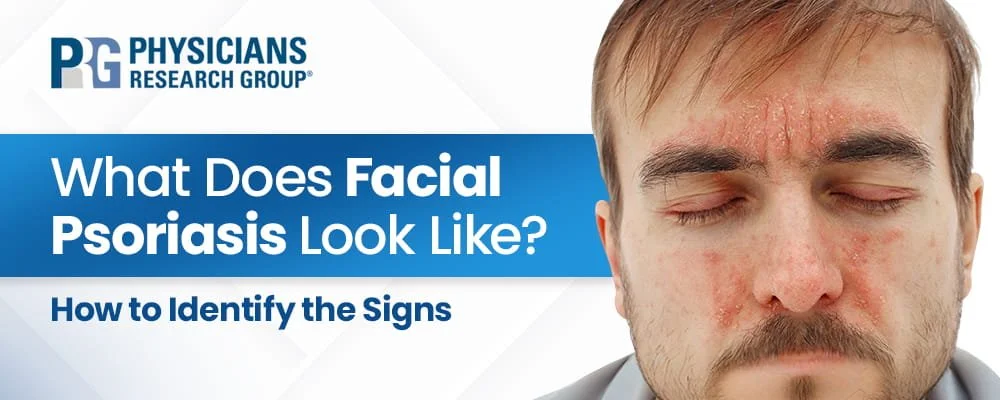
Facial psoriasis can appear as thickened, discolored patches of skin covered with dry scales. These patches, known as plaques, may develop on the forehead, cheeks, chin, eyebrows, nose, or around the mouth and eyes. The appearance can vary depending on the type of psoriasis and the person’s skin tone.
On lighter skin tones, affected areas may look red or pink and often have visible scaling. On darker skin tones, redness can be less noticeable. Instead, psoriasis may appear purple, brown, or darker than the surrounding skin.
The affected skin may feel dry, itchy, irritated, raised, or thicker than the surrounding skin. Facial psoriasis often forms well-defined patches, which can make the affected areas appear clearly different from nearby skin. Scaling or flaking may also be noticeable, particularly when the skin becomes very dry.
Because facial psoriasis can resemble other skin conditions, its appearance alone may not be enough to identify the condition.
What Are the Different Types of Psoriasis That Affect the Face?
Different types of psoriasis can involve the facial skin. Their appearance and symptoms may vary depending on the type.
Plaque Psoriasis:
This common form of psoriasis produces thick, dry patches covered with scales. On the face, these patches may look discolored and clearly defined.
Guttate Psoriasis:
This type causes many small, scaly spots rather than larger patches. It can develop following a streptococcal infection.
Pustular Psoriasis:
Pustular psoriasis is characterized by small, pus-filled bumps that develop alongside areas of dry and scaly skin.
Sebopsoriasis:
Sebopsoriasis combines characteristics of psoriasis and seborrheic dermatitis. It commonly causes flaky or scaly skin in areas where seborrheic dermatitis tends to occur.
Scalp Psoriasis
Scalp psoriasis causes thickened, discolored, and scaly areas on the scalp. The condition may also affect skin surrounding the scalp, including the hairline.
Where Can Facial Psoriasis Appear?
Facial psoriasis can affect different areas of the face, and its appearance may vary depending on where it develops.
Hairline and Forehead:
Psoriasis on the scalp can extend beyond the hairline and affect the upper forehead. This may cause dry, scaly, discolored, or thickened patches along the hairline and nearby skin.
Eyebrows and Around the Eyes:
Psoriasis may cause scaling, dryness, or discolored patches around the eyebrows and eyelids. Because the skin around the eyes is delicate, people should seek medical guidance before using treatments in this area.
Nose and Cheeks:
Facial psoriasis can develop around the nose and across the cheeks, where it may appear as dry, scaly, or discolored patches. These areas may also feel itchy or irritated.
Ears and Behind the Ears:
Psoriasis can affect the outer ears and the skin behind the ears, causing dryness, scaling, and thickened or discolored patches. When scalp psoriasis is present, scaling may also extend from the scalp toward the ears.
How Can You Tell If You Have Psoriasis on Your Face?
Persistent dry, scaly patches: Dryness and scaling may remain on affected areas and cause visible flaking.
Itching or burning: Affected skin may feel itchy, irritated, or produce a burning sensation.
Thickened or raised skin: Psoriasis can cause affected areas to become thicker or raised compared with nearby skin.
Cracking or irritation: Severe dryness may cause the skin to crack, become sore, or feel irritated.
Symptoms that come and go in flares: Symptoms may improve for a while and return during periods known as flares.
Similar patches on other areas of the body: Psoriasis may also affect areas such as the scalp, elbows, knees, or other parts of the body.
What Can Facial Psoriasis Be Mistaken For?
Facial psoriasis can resemble several other skin conditions because they may also cause dryness, scaling, redness, itching, or irritation. However, their appearance, location, and symptoms can differ.
Seborrheic Dermatitis:
Seborrheic dermatitis can cause red or discolored patches with flaky scales, particularly around the eyebrows, sides of the nose, and hairline. The scales may look white or yellowish and greasy, while psoriasis often produces thicker, more defined patches.
Eczema:
Eczema can cause dry, itchy, and irritated skin, which may look similar to facial psoriasis. However, eczema usually causes more intense itching, while psoriasis may cause burning, stinging, or discomfort. Psoriasis also tends to form more clearly defined, thicker patches.
Rosacea:
Rosacea commonly causes facial redness and irritation, especially across the nose and cheeks. It may also cause visible blood vessels or small bumps. Unlike psoriasis, rosacea typically does not produce thick, well-defined, scaly plaques.
Fungal Infections:
Fungal infections such as ringworm can cause red, scaly patches that may resemble psoriasis. Ringworm often forms a ring-shaped rash with a clearer center, while psoriasis usually creates more solid, defined patches. Because fungal infections require different treatment, an accurate diagnosis is important.
When Should You See a Healthcare Professional?
You should consider seeing a healthcare professional if facial skin changes persist, worsen, or become difficult to manage.
Persistent facial patches: Patches that do not improve or continue to return may need professional evaluation.
Spreading or worsening symptoms: Seek medical advice if patches spread or become increasingly irritated, painful, or uncomfortable.
Eye or eyelid involvement: Symptoms affecting the eyes or eyelids should be evaluated because the skin in this area is particularly delicate.
Uncertainty about the cause: A healthcare professional can help determine whether the symptoms are psoriasis or another skin condition with similar features.
Symptoms affecting daily life: Ongoing itching, burning, irritation, or discomfort that interferes with daily activities may require medical attention.
Ready to Explore New Options for Plaque Psoriasis?
Clinical research may offer access to investigational treatments while helping advance psoriasis care.
How Is Facial Psoriasis Diagnosed?
A healthcare professional or dermatologist can usually diagnose facial psoriasis by examining the affected skin and reviewing your symptoms. They may also ask about your medical history, including when the skin changes started and whether similar symptoms have occurred before.
Because facial psoriasis can resemble other skin conditions, additional testing may sometimes be needed to confirm the diagnosis or rule out other causes. In some cases, a skin biopsy may be performed, where a small sample of skin is examined under a microscope.
How Is Facial Psoriasis Treated?
Treatment for facial psoriasis depends on the severity of symptoms and the areas affected. A healthcare professional can recommend an appropriate approach based on your individual needs.
Topical Treatments:
Prescribed creams or ointments may help reduce inflammation, scaling, and other symptoms. Options can include corticosteroids and other nonsteroidal topical treatments. Moisturizers may also help relieve dryness and flaking.
Other Treatment Options:
When topical treatments are not enough or psoriasis is more severe, a healthcare professional may consider other therapies. These may include light therapy or systemic treatments, including certain immunosuppressants and biologic medicines.
Why Does Facial Psoriasis Require Special Care?
Facial skin is thinner and more sensitive than skin on many other parts of the body. A treatment that is suitable for psoriasis on the arms or legs may not be appropriate for the face.
Follow Your Healthcare Professional’s Guidance:
Use psoriasis treatments as directed by your healthcare professional, especially when applying them near the eyes or eyelids. Your doctor can also explain potential side effects and help determine which treatment is appropriate for your skin.
Clinical Trials in Dermatology
Clinical trials in dermatology help researchers study potential new treatments and better understand a range of skin conditions. Research studies are currently being conducted for various chronic skin conditions. One example is a plaque psoriasis clinical trial currently recruiting in Arizona. The study is evaluating two study treatments to learn about their safety and tolerability in adults aged 40 and older with moderate-to-severe plaque psoriasis. By participating, you will get study-related care, regular health checks, and monitoring throughout the study.
Conclusion
In conclusion, facial psoriasis can cause persistent, scaly, discolored, and irritated patches. Because these symptoms can resemble other skin conditions, proper diagnosis is important. Facial skin also requires careful treatment, particularly around the eyes. A healthcare professional can identify the cause and recommend appropriate treatment based on your symptoms.
Disclaimer: This blog is for general educational purposes only and does not replace professional medical advice, diagnosis, or treatment. If you have health concerns, consult a qualified healthcare professional.