
Facial Psoriasis vs Eczema: How to Tell the Difference
Key Takeaways
Facial psoriasis and eczema can look alike. Edges, scale, itch and location often give clues.
Psoriasis comes from an overactive immune system. Eczema is a group of skin conditions shaped by genes and triggers.
Eczema usually itches more, but psoriasis can itch less intensely and may also cause burning.
Neither psoriasis nor eczema is contagious, and while there’s no cure for either condition, both can be managed with the right treatment.
Quick Answer: In facial psoriasis vs eczema, psoriasis tends to form thicker, clearly outlined scaly patches, often near the hairline or eyebrows. Eczema tends to look drier and softer-edged, and it usually itches more. The two overlap a lot on the face, so a dermatologist has to confirm which one you have.
Introduction
You're brushing your teeth when you spot it: a red or darker, flaky patch near your eyebrow that wasn't there last week. Maybe it itches. Maybe it just feels tight. So what is it? Dry skin, eczema, or psoriasis?
It's a fair question. About 50% of people with psoriasis get it on their face at some point, according to the National Psoriasis Foundation. Meanwhile, more than 31 million Americans have some form of eczema, according to the National Eczema Association. With numbers like that, it's easy to see how the two get mixed up.
The good news is that when it comes to facial psoriasis vs eczema, the two tend to leave different clues In this blog, we'll walk through how each one looks, how it feels, and how it's treated. We'll also cover when a face rash is worth a doctor's visit.
Facial Psoriasis vs. Eczema: Understanding Each Condition
Psoriasis and eczema are both inflammatory skin conditions, and some of their symptoms overlap. Still, they aren't the same condition.
Psoriasis is a chronic, or long-term, skin condition that causes raised, scaly patches called plaques. Facial psoriasis often shows up alongside psoriasis on the scalp or elsewhere on the body.
On the other hand, eczema is a group of inflammatory skin conditions that leave skin dry, itchy, and sensitive. Atopic dermatitis is the most common type. On the face, you may also see seborrheic dermatitis or contact dermatitis.
Neither condition is contagious, and researchers don't fully know what causes either one.
What Is the Difference Between Psoriasis and Eczema on the Face?
The main difference between psoriasis and eczema on the face is what's happening in the skin. Psoriasis speeds up skin cell growth. Eczema weakens the skin's protective barrier.
Psoriasis is a case of skin cells growing too fast. An overactive immune response drives it. Skin cells normally take about three to four weeks (21 to 28 days) to grow and shed, but in psoriasis it can take just three to four days. The cells pile up on the surface instead of shedding.
Eczema is a case of a weakened skin barrier. People develop it through an interaction between genes and environmental triggers. The immune system is involved, but the National Eczema Association says eczema isn't an autoimmune disease. Instead, the weakened barrier leaves skin dry and easily irritated.
Two more clues can help. Psoriasis often peaks between ages 20 and 30 and again between 50 and 60, while eczema often starts in childhood. Eczema also often runs alongside allergies, asthma, or hay fever, or with a family history of them. None of these clues can settle it alone, though.
Facial Psoriasis vs Eczema Appearance: What Does Each Look Like?
Here’s a quick comparison of facial psoriasis vs eczema appearance. While both can look similar, there are some differences worth knowing.
| Facial Psoriasis | Facial Eczema | |
|---|---|---|
| Edges | Often sharply defined | Often blurrier |
| Texture | Thicker, raised, scaly | Drier, rough, flaky |
| Itch | Common, often mild to moderate; may also burn or sting | Usually stronger, and can be intense |
| Common Spots | Hairline, eyebrows, eyelids, around the nose and ears | Cheeks, eyelids, around the mouth, under facial hair |
| Clues Elsewhere | Scalp patches are common | History of asthma, hay fever or allergies is common |
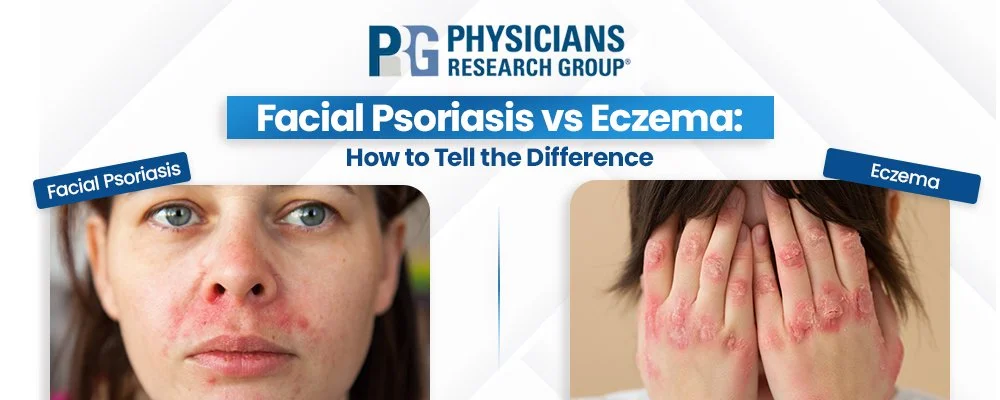
What does facial psoriasis look like?
Psoriasis patches are raised, inflamed and scaly. On lighter skin they're usually red with silvery-white scale. Dermatologists describe a few common patterns on the face:
Hairline psoriasis: Patches along the edge of the hairline, often linked to scalp psoriasis.
Sebo-psoriasis: Thin, salmon-pink patches with fine scale on the eyebrows, eyelids and the creases beside the nose.
True facial psoriasis: Sharply defined patches, often matching on both sides of the face.
Most people with facial psoriasis also have it on the scalp. Psoriasis on the face alone is very rare, so scalp patches are a useful clue.
What does facial eczema look like?
Facial eczema usually shows up as dry, rough, flaky patches with itching, burning or stinging. Some people also get crusting or small blisters. On lighter skin the patches look pink or red. On darker skin they can look dark brown, gray or purple.
Exploring New Possibilities for Your Skin?
You may be eligible to participate in a clinical research study evaluating an investigational treatment for atopic dermatitis.
Psoriasis vs Eczema on the Face: Where Does Each Tend to Show Up?
Psoriasis often turns up on the forehead, hairline, eyebrows, eyelids, around the nose and ears, and on the cheeks. Eczema tends to appear on the cheeks, forehead, around the eyes, nose and mouth, and under facial hair. Babies often get it on their cheeks, while adults more often get it around the eyes, mouth or beard area.
You may have heard that eczema sits in skin folds and psoriasis on elbows and knees. That rule doesn't help much on the face, and there's plenty of overlap, so location alone won't settle it.
How do they look on darker skin?
Both conditions can look purple, gray or dark brown instead of red, and redness can be harder to see. On darker skin, color is a weaker clue, so texture, scale and how the patch feels can tell you more.
Facial Psoriasis vs Eczema Symptoms
Symptoms of facial psoriasis:
Raised patches: The affected skin may feel raised or thicker than the surrounding skin.
Inflammation: Patches can look irritated and inflamed.
Scaling: The skin may develop a noticeable buildup of flaky or scaly skin.
Itching: Some people experience itching in the affected areas.
Soreness or pain: Psoriasis patches can feel tender, sore, or painful.
Color changes: On lighter skin, patches may look red with silvery-white scaling. On darker skin, they may appear darker brown, purple, or grayish and can be thicker.
Symptoms of facial eczema:
Dry, rough skin: Areas of the face may feel dry, tight, or rough to the touch.
Flaking: The affected skin can peel or shed small flakes.
Itching: It is common and can sometimes be intense.
Burning or stinging: The skin may feel irritated, especially after using certain skincare products.
Redness or discoloration: The affected area may look red, darker, or otherwise different from the surrounding skin, depending on skin tone.
Cracking or small blisters: More severe flares can cause painful cracks or tiny fluid-filled blisters.
Crusting or greasy scaling: This can occur with certain types of eczema, including seborrheic dermatitis.
Psoriasis Vs Eczema on Face: Which One Itches More?
Eczema is known for itch, and the itch can be intense enough to disrupt sleep.
There's a common myth here that psoriasis doesn't itch. It does. Studies find itch in roughly 60 to 90 percent of people with psoriasis, often at a moderate level. It can also burn, sting or feel sore.
So eczema usually itches more, but itch on its own can't tell you which one you have.
Psoriasis vs Eczema in Children
Both psoriasis and eczema can affect children, and the two may look similar at first. Eczema is particularly common in babies and often appears on the face, especially the cheeks, forehead, and scalp.
Psoriasis can affect babies and children too, but it tends to cause more clearly defined, scaly patches. On darker skin, the patches may look brown, violet, or gray rather than red, which can make them harder to recognize.
Because childhood rashes can have several causes, a pediatrician or dermatologist can help determine whether the skin changes are eczema, psoriasis, or another condition.
How Do Doctors Diagnose Facial Psoriasis and Eczema?
There’s no single test. A doctor considers how the rash looks, where it appears, your symptoms, and your history. Most cases can be diagnosed by examining the skin. Patch testing or a small skin biopsy may help when the diagnosis is unclear.
You can make the appointment more useful by bringing:
Dated photos of the rash when it started, at its worst, and after any treatment.
A list of everything that touches your face, including makeup, sunscreen, shampoo and facial hair products.
Notes on any patches on your scalp, ears or elsewhere on your body.
Family history of psoriasis, eczema, asthma or allergies.
What you've already tried and what happened.
Anything that seems to set it off, like stress, weather or a new product.
Facial Psoriasis vs Eczema Treatment
Both conditions may need topical treatment, but facial skin is thinner and more sensitive than skin on many parts of the body. That means treatment strength and how long you use it matter.
Topical anti-inflammatory treatments are generally used more cautiously on the face. Stronger options may be limited to short periods because prolonged use can cause skin thinning and other side effects, especially around the eyes. The right strength and duration depend on the diagnosis and area being treated.
Common options for facial psoriasis:
Treatment depends on how severe the psoriasis is and where it appears. Options may include:
Mild anti-inflammatory creams or ointments.
Non-steroid anti-inflammatory treatments, particularly for sensitive areas such as the eyelids.
Other non-steroid prescription treatments.
Phototherapy or treatments that work throughout the body for stubborn or widespread psoriasis.
Common options for facial eczema:
Eczema treatment focuses on calming inflammation and supporting the skin barrier. Options may include:
Fragrance-free moisturizers used regularly.
Low-strength topical anti-inflammatory treatments for short periods during flares.
Non-steroid anti-inflammatory treatments for some sensitive areas.
Avoiding irritants or allergens that may trigger flares.
Different treatment when the symptoms are caused by another condition, such as seborrheic dermatitis.
Can the same treatment work for both?
Sometimes. Both conditions involve inflammation, so some treatment categories overlap. But they aren't interchangeable. The appropriate treatment depends on the diagnosis, severity, and location.
For either condition, gentle skin care helps.
Use a mild cleanser.
Moisturize regularly.
Protect your face from the sun.
Don't use a leftover strong anti-inflammatory cream on your face unless a clinician has recommended it.
When Should You See a Doctor?
Facial psoriasis and eczema can look similar, and some other skin conditions can cause similar symptoms. You should seek medical advice if the rash is painful, spreading, affecting the eyelids or eyes, or interfering with your daily life. Getting the right diagnosis matters because psoriasis and eczema may require different treatment approaches.
Can Clinical Research Help with Psoriasis or Eczema?
When symptoms continue despite treatment, some people may also be interested in clinical research. Clinical trials give researchers a way to study new treatment approaches for conditions such as plaque psoriasis and atopic dermatitis.
Physicians Research Group (PRG) conducts clinical research in several therapeutic areas, including dermatology. Its research studies include clinical trials for moderate-to-severe plaque psoriasis and atopic dermatitis, where eligible participants can be evaluated and monitored by a research team throughout the study.
If you or someone you know is living with psoriasis or eczema, learn more about PRG and explore the clinical research opportunities available to eligible participants.
Ready to Explore New Options for Plaque Psoriasis?
Clinical research may offer access to investigational treatments while helping advance psoriasis care.
Conclusion
Facial psoriasis and eczema can look surprisingly similar, but they aren’t the same condition. Psoriasis often causes thicker, well-defined, scaly patches, while eczema tends to cause dry, sensitive, and intensely itchy skin.
Because symptoms and appearance can overlap, especially on the face, it’s not always possible to tell them apart by looking alone. If your symptoms persist or aren’t improving, a dermatologist can help identify the cause and recommend the right treatment.
FAQs
-
Psoriasis often causes thicker, well-defined, scaly patches, while eczema usually causes dry, rough, itchy, and sensitive skin. Because they can look similar, a dermatologist may be needed for a diagnosis.
-
Yes. Both can cause dry, irritated, itchy, or discolored patches. Psoriasis often has thicker scaling, while eczema tends to be drier and itchier.
-
Yes. Having one condition does not completely rule out the other, although they are different inflammatory skin conditions.
-
It can affect the hairline, forehead, eyebrows, eyelids, nose, ears, and cheeks. It may also occur alongside psoriasis on the scalp or other parts of the body.
-
Facial eczema can affect the cheeks, forehead, areas around the eyes, nose, mouth, and facial hair. The pattern can vary with age and the type of eczema.